

Learn how to integrate the Singapore Maths CPA approach into everyday life, make learning fun, build your child’s problem-solving skills, and prepare them for school, from preschool puzzles to PSLE challenges. This guide will help you build your child’s confidence and competence in mathematics.
The Basics of Home-Based Maths Learning
Before diving into complex topics, it is crucial to build a solid foundation. This means understanding the core principles of the Singapore Maths method and weaving mathematical concepts into your daily family life. A strong start makes learning future topics much easier.
Understanding the Singapore Maths Approach (The CPA Framework)
The Singapore Maths curriculum is globally recognised for its effectiveness, largely due to the Concrete, Pictorial, Abstract (CPA) approach. This framework ensures children develop a deep understanding of concepts rather than just memorising formulas.
- Concrete: This is the “doing” stage. Children use physical objects to solve maths problems. For instance, if the problem is 4 + 2, they would use six building blocks to count and find the answer. This hands-on experience makes abstract concepts tangible and easier to grasp.
- Pictorial: This is the “seeing” stage. Once a child is comfortable with physical objects, they move on to drawing representations. For the same problem, they would draw four squares and then two more squares to visually represent the equation. This is where Singapore’s famous “model drawing” technique comes into play.
- Abstract: This is the “symbolic” stage. After mastering the concrete and pictorial stages, children are ready to use numbers and symbols (e.g., 4 + 2 = 6). They now understand the logic behind the equation, not just how to calculate it.
Integrating Maths into Daily Routines
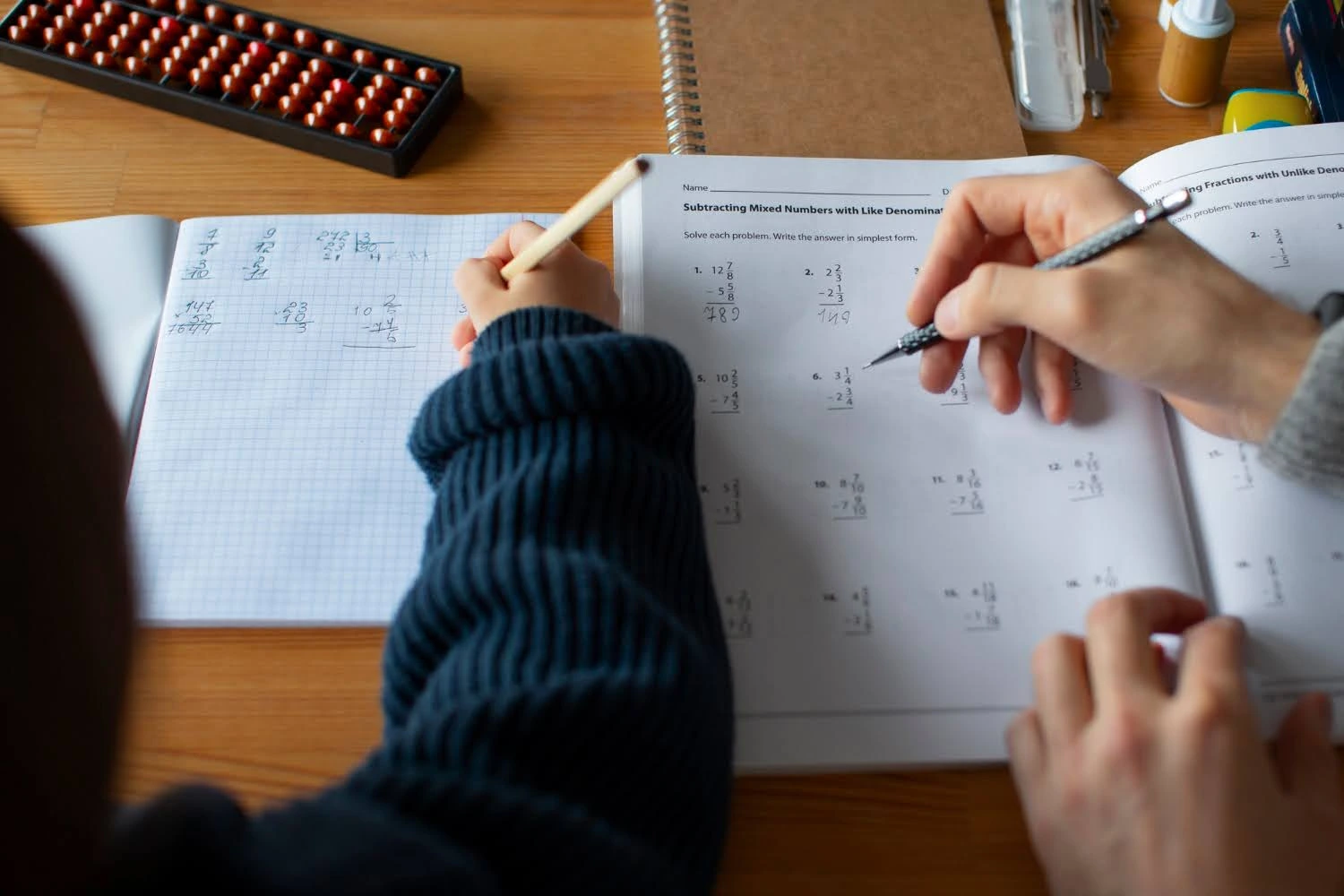
Maths is not just for the classroom. You can find learning opportunities in almost every daily activity. This makes maths relevant and less intimidating for children.
- In the Kitchen: Cooking and baking are filled with maths. Let your child help with measuring ingredients (volume and weight), counting the number of eggs needed, or timing the bake. You can also ask them to help divide a pizza or cake into equal slices to teach fractions.
- During Playtime: Use playtime to reinforce maths concepts. Ask your child to sort their toys by size, shape, or colour. When building with LEGOs or blocks, count the pieces used and talk about the different shapes and structures they are creating.
- At the Supermarket: A trip to the grocery store is a great learning experience. Younger children can practise counting fruits and vegetables. Older children can be involved in comparing prices, weighing items, or estimating the total cost of the items in your trolley.
Developing Strong Number Sense from an Early Age
Number sense is the intuitive understanding of numbers and their relationships. A child with strong number sense can visualise and talk about numbers comfortably.
- Counting: Regularly count forwards and backwards with your child. Count steps as you walk, toys as you tidy up, or snacks as you hand them out.
- Pattern Recognition: Help your child see patterns in numbers, shapes, and colours. This builds a foundation for more complex mathematical thinking.
- Comparisons: Use words like “more than,” “less than,” and “equal to” in daily conversation. For example, “You have more red blocks than blue blocks.”
Essential Tools and Resources for Teaching Maths at Home

Having the right tools can make teaching maths at home more structured and effective. These range from physical objects to digital apps, catering to different learning styles.
1. Must-Have Manipulatives and Physical Tools
Manipulatives are physical objects that help children visualise mathematical concepts. They are a core part of the “Concrete” stage in the CPA approach.
- Counting Blocks or Cubes: These are excellent for teaching counting, addition, subtraction, and even multiplication.
- Abacus or Counting Frames: A classic tool for developing number sense and understanding place value.
- Measuring Tapes, Rulers, and Weighing Scales: Essential for teaching concepts of length, height, and weight in a practical way.
- Play Money: A fun tool for teaching financial literacy, including counting money and giving change.
2. Recommended Books and Workbooks Aligned with the MOE Syllabus
While hands-on learning is key, workbooks provide structured practice that is essential for reinforcing concepts taught in school.
- Choosing the Right Books: Look for assessment book series that are popular and well-regarded by parents and tutors in Singapore. Ensure the book is appropriate for your child’s level, it should be challenging but not so difficult that it causes frustration.
- Focus on Quality, Not Quantity: It is better to complete one workbook thoroughly than to rush through several. Ensure your child understands the concepts behind the questions, rather than just getting the right answer.
3. Vetted Online Resources and Apps
In today’s digital age, online resources can be a great supplement to traditional learning methods.
- Reputable Platforms: Websites like Khan Academy offer free, high-quality video lessons on a vast range of maths topics. In Singapore, platforms like Koobits are designed to align with the local school curriculum and make learning interactive.
- Managing Screen Time: While educational apps can be beneficial, it is important to balance them with other forms of learning. Set clear limits on screen time and choose apps that encourage active problem-solving rather than passive viewing.
Making Maths Fun and Engaging: Creative Activities for Different Age Groups

The key to keeping a child motivated is to make learning enjoyable. Tailoring activities to your child’s age and interests can transform maths from a chore into a fun challenge.
For Preschoolers (Ages 4-6): Learning Through Play
At this age, learning should be almost entirely play-based. The goal is to build a positive association with maths.
- Maths Games: Simple board games that use a dice are fantastic for teaching counting and one-to-one correspondence. Card games like Snap or Uno help with number recognition.
- Storytelling with Maths: Create simple stories that involve maths. For example, “Three little ducks went for a swim. One more duck joined them. How many ducks are there now?”
- Art and Craft: Use arts and crafts to explore shapes and patterns. Let your child create pictures using pre-cut shapes or make necklaces by threading beads in a repeating pattern.
For Lower Primary (Ages 7-9): Building on Concepts
Children in this age group can handle more structured activities, but the focus should still be on making them fun and interactive.
- “Maths Treasure Hunts”: Write down maths problems on pieces of paper and hide them around the house. Each correct answer provides a clue to the location of the next problem, leading to a small prize at the end.
- Building with LEGOs: LEGOs are an excellent tool for exploring more complex topics like fractions (e.g., “If this long brick is one whole, show me what half looks like”), symmetry, and 3D shapes.
- Setting Up a “Shop”: Let your child set up a pretend shop with their toys. They can create price tags and practise addition, subtraction, and giving change as you “buy” items from them.
For Upper Primary (Ages 10-12): Tackling Complex Problems
As children approach the PSLE, the focus shifts to problem-solving and critical thinking. The key is to connect maths to real-world situations.
- Real-World Problem Solving: Involve your child in planning a family outing. Let them help budget for tickets, food, and transport. They can also use an MRT map to calculate the fastest route and estimated travel time.
- Coding Games: Many introductory coding games for kids are based on mathematical logic and problem-solving. This is a great way to show them a modern and exciting application of maths.
- Exploring Heuristics: Heuristics are problem-solving strategies taught for the PSLE. Instead of just drilling them from a workbook, turn them into challenges. For example, present a complex problem sum as a mystery that needs to be solved using a specific strategy, like “working backwards.”
3 Ways to Support a Struggling Child

It is common for children to struggle with maths at some point. The way parents respond can make a huge difference in their child’s confidence and long-term attitude towards the subject.
1. Identifying the Root Cause of the Struggle
Before you can help, you need to understand why your child is struggling.
- Specific Topics: Is there a particular concept, like fractions or long division, that they find difficult? Often, a weakness in a foundational topic can affect their ability to learn more advanced concepts.
- Maths Anxiety: Sometimes, the issue is not a lack of ability but anxiety. A child might fear making mistakes or feel pressured to be fast, which can hinder their performance.
- Learning Difficulties: Be aware of common signs of learning difficulties, such as trouble recalling basic math facts, difficulty understanding symbols, or struggling to follow multi-step procedures.
2. Strategies to Build Confidence
A confident child is more likely to be a resilient learner.
- Praise Effort, Not Just Results: Focus on your child’s effort and progress. Instead of saying “You’re so smart,” try “I’m so proud of how hard you worked on that difficult problem.”
- Break It Down: If a problem seems overwhelming, help your child break it down into smaller, more manageable steps. Solving one small part can build the momentum needed to tackle the whole problem.
- Create a Positive Environment: Frame mistakes as valuable learning opportunities. Avoid showing frustration and maintain a calm, encouraging tone.
3. When to Consider Professional Help: The Role of a Maths Tutor
Sometimes, a child may need more targeted support than a parent can provide.
- Signs You Might Need a Tutor: If your child consistently struggles despite your help, has fallen significantly behind, or is developing strong maths anxiety, it might be time to seek professional help.
- Benefits of a Specialist Tutor: A good maths tutor can identify specific learning gaps and provide personalised instruction. They are experienced in different teaching methods and can find the one that works best for your child.
- What to Look For: In Singapore, look for a tuition programme that has a deep understanding of the MOE syllabus, uses the CPA approach, and focuses on building genuine understanding rather than rote memorisation.
Advanced Tips For Parents Aiming For Excellence
For parents whose children are comfortable with the basics, the next step is to cultivate a deeper level of mathematical thinking and problem-solving skills, which are crucial for success in the PSLE and beyond.
Introducing Heuristics
Heuristics are essential problem-solving strategies taught in Singapore schools. They are not formulas but rather ways of thinking about and approaching a problem.
- Simple Explanations: Introduce heuristics in a simple way. For instance, “model drawing” is just drawing boxes to represent the numbers in a problem. “Working backwards” is a strategy you use when you know the end result but need to find the starting point.
- Make It Relatable: Use everyday scenarios to explain these strategies. For example, if you know you have $20 left after shopping and you spent $50, you can “work backwards” to find out you started with $70.
Fostering a “Growth Mindset” Towards Mathematics
A growth mindset is the belief that abilities can be developed through dedication and hard work.
- Emphasise Development: Teach your child that everyone can get better at maths with practice. Avoid phrases like “I’m not a math person,” as this promotes a fixed mindset.
- Embrace Challenges: Encourage your child to see challenging problems as opportunities to learn and grow their brain. Mistakes are not failures but stepping stones to understanding.
Connecting Maths to Future Careers and Interests
Making maths relevant to your child’s life and future aspirations can be a powerful motivator.
- Explore Applications: Show your child how maths is used in professions they find exciting. A video game designer uses geometry, an architect uses measurement and scale, and a data scientist uses statistics.
- Link to Hobbies: Connect maths to their hobbies. If they love sports, you can analyse player statistics. If they enjoy music, you can explore the mathematical patterns in rhythm and harmony.
Conclusion On Teaching Math to Children at Home
Teaching maths at home in Singapore is about more than just completing worksheets; it’s about creating a positive and engaging learning environment. By integrating maths into daily life through cooking or shopping, using the Concrete, Pictorial, Abstract approach, and playing fun, educational games, parents can build a strong and lasting foundation.
For older children approaching the PSLE, focusing on real-world problem-solving and introducing heuristics can transform complex challenges into manageable tasks. Throughout this journey, it is vital to foster a growth mindset, celebrating effort over grades.
Remember to be patient, observe your child’s needs, and know when to seek professional support from a specialist tutor. These strategies will not only help improve academic performance but also build your child’s lifelong confidence in tackling mathematical problems.
Make your at-home tutorials even more fun with Tutify. If you are interested or if you have any questions, send us a message and we’ll get back to you with an answer.
Frequently Asked Questions About Teaching Math to Children at Home
How Can I Make Learning Maths Fun for My Child?
Incorporate maths into activities your child already enjoys. Use board games, cooking, storytelling, and even outdoor play to introduce mathematical concepts. For example, measure ingredients together, play card games that involve counting, or go on a “shape hunt” in your neighbourhood. The key is to make it interactive and relevant to their world.
What Is the Singapore Maths Method and Why Is It So Effective?
The Singapore Maths method is centred on the Concrete, Pictorial, Abstract (CPA) approach. It focuses on helping children develop a deep conceptual understanding before moving to procedural fluency. Children first learn with physical objects (Concrete), then move to drawing models (Pictorial), and finally work with numbers and symbols (Abstract). This ensures they know the “why” behind the maths, not just the “how.”
How Much Time Should We Spend on Maths at Home Each Day?
Consistency is more important than duration. For younger children, 10-15 minutes of focused, fun maths activity each day is very effective. For primary school children, this could be 20-30 minutes of homework or guided practice. The goal is to keep sessions short, positive, and engaging to avoid burnout.
My Child Hates Maths. What Can I Do to Change Their Attitude?
Start by identifying the root cause of their dislike, it could be anxiety, a specific topic they don’t understand, or a belief that they are “bad at maths.” Shift the focus from performance to effort. Celebrate small successes, use hands-on activities instead of just worksheets, and connect maths to their interests, like sports statistics or video games.
How Do I Know if My Child Needs a Maths Tutor?
Consider a tutor if your child consistently struggles with homework despite your help, shows high levels of frustration or anxiety about maths, has fallen significantly behind their peers, or if their school teacher has raised concerns. A good tutor can provide targeted support and help rebuild their confidence.
Where Can I Find Good Maths Resources That Align With the Singapore Syllabus?
Popular local bookstores carry a wide range of assessment books and workbooks that are aligned with the MOE syllabus. For online resources, platforms like Koobits are designed specifically for the Singapore curriculum. Additionally, the websites of top tuition centres often have free resources, articles, and tips for parents.