
For many, a love for numbers fades the moment mathematics starts to feel like an impossible puzzle. A child struggling in math may lose not only marks in school but also the motivation to try, making each lesson feel heavier than the last.
Yet behind every formula and theorem lies a fascinating story that can inspire a fresh perspective. Learning about who invented math can help students regain confidence in mathematics by showing that it grew from simple ideas, developed step by step over centuries.
In this article, you will discover the origins of mathematics, the people and civilisations that shaped it, and how its growth continues to influence the way we learn today. By the end, you may see math in a new light that makes it easier to connect with and appreciate.
Who Invented Mathematics? The Short Answer
No single person can truly claim the title of the person who invented math. Mathematics grew over thousands of years, shaped by the needs and ideas of many cultures.
Early societies such as Mesopotamia, Egypt, India, China, and Greece each made important contributions. They developed skills ranging from simple counting and measuring to advanced geometry and algebra.
Rather than being the creation of one individual, math is the result of countless discoveries built upon over time. It stands today as a shared human achievement that connects us across centuries.
Earliest Evidence of Mathematics in Human History
The first traces of mathematics appeared long before the invention of writing. Archaeological finds show that humans were counting, measuring, and recognising patterns tens of thousands of years ago.
Examples include:
- Ishango Bone – Found in Africa, around 20,000 years old, with carved notches believed to represent counting or sequences.
- Lebombo Bone – Discovered in southern Africa, about 35,000 years old, possibly used as a lunar calendar.
These early tools suggest that mathematics began as a way to meet practical needs, such as:
- Tracking food supplies
- Measuring time and seasons
- Managing trade or exchanges
Over centuries, these basic skills evolved into structured systems, paving the way for the mathematical breakthroughs of ancient civilisations.
Ancient Civilisations That Pioneered Mathematics
Mesopotamia – Base-60 System and Early Algebra
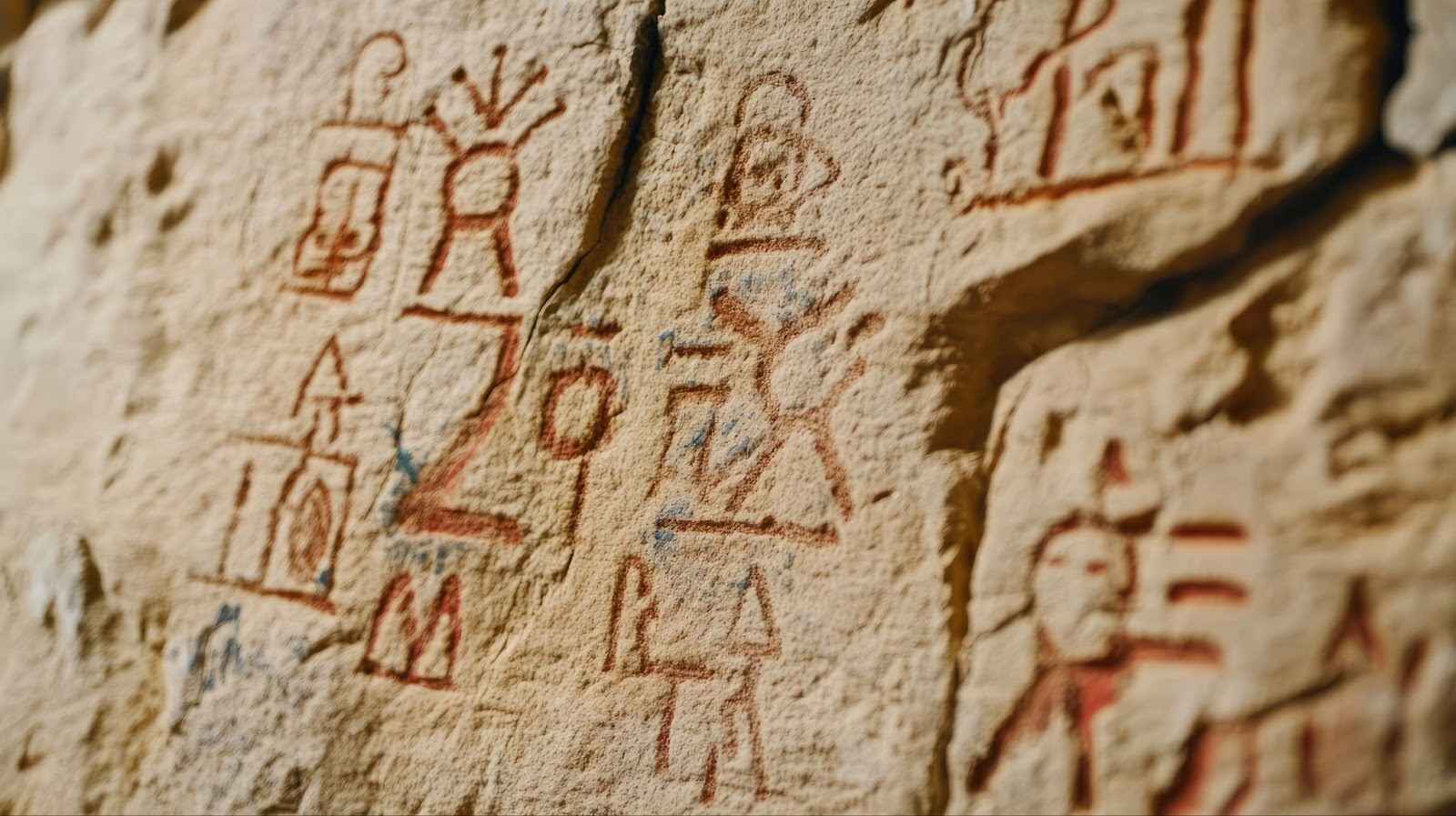
In Mesopotamia, the Babylonians developed a number system based on 60. This system still influences how we measure time and angles today. They recorded their calculations on clay tablets and solved problems involving algebra, geometry, and astronomy.
Egypt – Geometry and Architecture
Ancient Egyptians applied mathematics to build their remarkable structures, including the pyramids. They developed formulas for calculating area, volume, and angles, and used geometry to manage farmland along the Nile after annual floods.
Greece – Foundational Theories and Proofs
Greek mathematicians like Pythagoras, Euclid, and Archimedes shifted math from practical problem-solving to a subject of logical reasoning and proof. They laid down the foundations of geometry, number theory, and mathematical proofs that are still taught today.
India – The Concept of Zero and Trigonometry
Indian scholars made one of the most significant contributions in history by formalizing the concept of zero. Mathematicians like Aryabhata and Brahmagupta advanced trigonometry, algebra, and astronomical calculations that influenced scholars worldwide.
China – Decimal System and Algebraic Solutions
Ancient Chinese mathematics introduced a decimal place value system and efficient methods for solving algebraic equations. They also made advancements in geometry and practical problem-solving for engineering and trade.
Mayans – Astronomy and Calendar Systems
The Mayans of Central America used mathematics to develop highly accurate calendar systems. Their knowledge of astronomy and complex numerical patterns allowed them to predict celestial events with remarkable precision.
Who Is the Father of Mathematics?
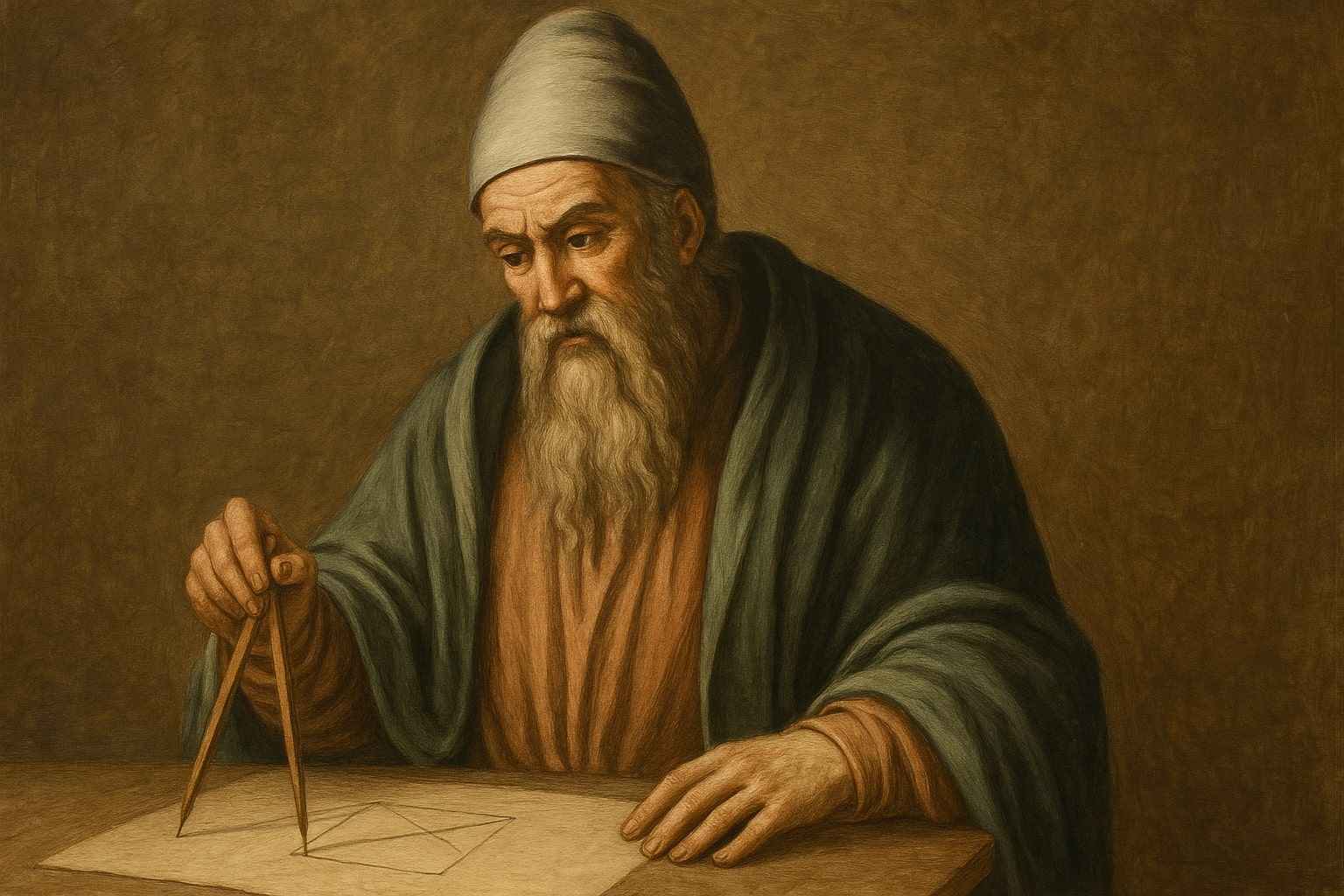
Euclid, a Greek mathematician from around 300 BCE, is widely recognised as the father of mathematics. His work shaped the way mathematics is studied and taught even today.
Key facts about Euclid:
- Author of Elements – A 13-book collection that organised geometry, number theory, and proofs into a logical framework.
- Methodical approach – Introduced a step-by-step structure for proving mathematical statements, known as the axiomatic method.
- Long-lasting influence – Elements was used as a primary mathematics textbook for over 2,000 years in schools around the world.
Euclid’s dedication to clarity and logical reasoning transformed mathematics from a set of practical techniques into a formal discipline, earning him this lasting title.
Key Figures Who Shaped Mathematics
Pythagoras – Geometry and Number Theory
Pythagoras, a Greek mathematician from the 6th century BCE, is best known for the Pythagorean theorem, which describes the relationship between the sides of a right-angled triangle. Beyond geometry, he explored number patterns and believed numbers formed the basis of understanding the world.
Archimedes – Principles of Calculus and Geometry
Archimedes, another Greek mathematician, made groundbreaking contributions to geometry, measurement, and mechanics. He used methods that anticipated integral calculus and developed formulas to calculate areas, volumes, and surface areas of various shapes.
Isaac Newton and Gottfried Leibniz – Calculus Development
In the 17th century, Isaac Newton in England and Gottfried Wilhelm Leibniz in Germany independently developed calculus. Newton used it to describe motion and gravity, while Leibniz introduced the notation still used in mathematics today.
Emmy Noether – Modern Algebra
Emmy Noether, a German mathematician of the early 20th century, revolutionised abstract algebra and theoretical physics. Her work on symmetry and algebraic structures remains fundamental to modern mathematics and science.
Al-Khwarizmi – Algebra’s Namesake
Al-Khwarizmi, a Persian mathematician from the 9th century, wrote influential works on algebra, arithmetic, and astronomy. His book The Compendious Book on Calculation by Completion and Balancing laid the foundations of algebra, and his name gave rise to the term “algorithm.”
How Mathematics Spread Across the World
Mathematics moved across continents through trade, exploration, and the sharing of knowledge between cultures. It grew stronger each time it reached a new civilisation, absorbing fresh ideas and methods.
Stages in its spread:
- Islamic Golden Age – Scholars in the Middle East translated and expanded Greek, Indian, and Persian works, introducing algebra, trigonometry, and refined numerical systems.
- Trade Routes – Paths such as the Silk Road carried mathematical concepts alongside goods. Merchants exchanged counting systems, measurement techniques, and navigational skills.
- European Renaissance – The revival of classical knowledge combined with innovations from the Islamic world. Printing presses made works like Euclid’s Elements accessible to more people.
This continuous exchange over centuries ensured that mathematics became a shared human achievement rather than the product of a single culture.
The Evolution of Mathematical Notation
Mathematical notation developed gradually, shaped by the needs of mathematicians across different cultures and eras. It transformed from simple markings to the universal symbols we recognise today.
Important milestones in its evolution:
- Ancient Systems – Egyptians used hieroglyphs for numbers, while Mesopotamians used cuneiform marks on clay tablets.
- Greek Influence – Letters represented numbers and concepts, with geometric diagrams explaining relationships.
- Indian Contributions – Development of the numeral system we use today, including the symbol for zero.
- Arabic Refinement – Spread of Hindu–Arabic numerals and introduction of new symbols for operations.
- Renaissance Innovations – Mathematicians like François Viète and René Descartes introduced algebraic notation, including variables for unknowns.
- Standardisation in the 17th Century – Widespread use of addition (+), subtraction (−), multiplication (×), division (÷), and equality (=) symbols.
This gradual standardisation made mathematics faster to write, easier to share, and more accessible across languages and cultures.
Math in the Modern World

Technology
Mathematics forms the foundation of computer programming, data encryption, artificial intelligence, and digital communication. From smartphones to satellites, mathematical algorithms keep systems operating efficiently and securely.
Science and Engineering
In fields such as physics, chemistry, medicine, and engineering, mathematics is essential for designing structures, analysing data, and modelling complex systems. Geometry, algebra, calculus, and statistics are applied to understand natural phenomena and create practical solutions.
Everyday Applications
Mathematics is part of everyday decision-making. Budgeting, cooking, comparing prices, and planning travel all involve basic calculations. Even areas like sports strategies, music theory, and visual art often use mathematical ideas, sometimes without us realising it.
Ongoing Development
As technology and society evolve, mathematics continues to grow, developing new tools and approaches to address future challenges. It remains a shared language that connects ideas, industries, and innovations across the globe.
Conclusion About Who Invented Mathematics
Mathematics is not the creation of a single mind but the result of countless contributions from civilisations and thinkers across history. From ancient counting tools to advanced theories, it has shaped how we understand and improve our world.
At Tutify, we believe in nurturing that journey. Our Critical Thinking training method has helped hundreds of students master mathematics, excel in Maths Olympiad, and secure places in top schools.
Contact us today to learn how we can help your child thrive in mathematics.
Frequently Asked Questions About Who Invented Mathematics
Who Invented Mathematics?
No single person invented mathematics. It developed over thousands of years through the work of many cultures.
Who Is The Father Of Mathematics?
Euclid is often called the father of mathematics for organising and formalising the subject in his work Elements.
When Was Mathematics First Used?
Evidence of counting and measuring dates back over 20,000 years, seen in ancient artefacts like the Ishango Bone.
Which Civilisation First Developed Advanced Mathematics?
Mesopotamia is often credited with early advances, including algebra and a base-60 number system.
Why Was Mathematics Created?
It began as a practical tool for solving problems in trade, farming, and astronomy.
How Did Mathematics Spread Across Cultures?
It spread through trade, exploration, and the exchange of knowledge, especially during the Islamic Golden Age and the Renaissance.
Who Contributed To The Concept Of Zero?
Indian mathematician Brahmagupta formalised the concept of zero in the 7th century.
What Are Some Modern Uses Of Mathematics?
It is used in technology, science, engineering, finance, and everyday problem-solving.