

Does your child understand the mathematical concepts but still lose marks in exams due to “silly” errors? You are not alone. Many students in Singapore face this frustration, seeing their grades slip from an AL1 or AL2 simply because of a calculation slip or a misread question.
Careless mistakes are often habitual, not accidental. This guide covers 17 practical strategies, from handwriting hacks to “sanity checks”, to help your child secure those top grades in Primary Math and Olympiad competitions. Read on to turn those lost marks into gained confidence.
17 Practical Ways to Reduce Careless Mistakes
Careless mistakes can be the difference between a pass and a distinction. While they are frustrating, the good news is that they can be fixed. By changing the way your child approaches their work and manages their exam time, you can significantly reduce these errors. Here is a comprehensive list of practical strategies you can implement immediately.
1. Maintain a “Mistake Log” or Error Notebook
The first step to fixing a problem is understanding it. A mistake log is not just a collection of wrong answers; it is a tool for pattern recognition. Parents can help their children improve their math memory.
Have your child keep a dedicated notebook. Every time they make a mistake in homework or a practice paper, they should record it. However, do not just copy the question. They must write down why they got it wrong. Was it a transfer error? Did they forget to convert units? Did they use the wrong formula?
Over time, you will see a pattern. If 50% of their errors are unit conversions, you know exactly what to target. This turns a vague problem (“I’m careless”) into a specific, solvable one (“I need to practice mass and length conversions”). Review this log before every major exam or PSLE simulation to keep these pitfalls fresh in their mind.
2. Practice Neatness and Column Alignment
In Primary Math, especially when dealing with long division, multiplication, or decimals, alignment is everything. Many students make calculation errors simply because their columns are crooked. A “7” in the tens place might accidentally be added to a “4” in the hundreds place if the writing is messy.
Encourage your child to use grid paper for their workings. This forces them to put one number in one box, ensuring perfect vertical alignment. If grid paper is not allowed in the exam, teach them to space their numbers out generously. Writing larger often helps. When the numbers are cramped, the brain has to work harder to distinguish them, which increases the cognitive load and the likelihood of a mistake.
3. Vocalise the Steps During Homework
This strategy utilizes auditory processing to reinforce focus. When your child is doing homework, encourage them to whisper the steps they are taking. For example, “I am moving the decimal point two spaces to the right” or “I am carrying over the three.”
When we think silently, our brains can sometimes skip ahead or drift off. Vocalising the action forces the brain to slow down and acknowledge each step. While they cannot talk aloud during the actual PSLE or Math Olympiad, this practice during homework builds a strong internal monologue that will guide them silently during the exam.
4. The “No Mental Math” Rule for Working
Singaporean students are often bright and quick, leading them to do simple calculations in their heads to save time. This is a high-risk habit.
Implement a strict rule: show all workings. Even if the calculation seems simple, like 15+27, write it down.
When students rely on mental math, they do not leave a trail. If they make a mistake, they cannot find it later when checking. By writing everything down, they offload information from their working memory to the paper. This frees up their brain to focus on the complex problem-solving parts of the question rather than holding numbers in their head.
5. The “Highlight and Underline” Technique
Misreading the question is one of the most common causes of mark deduction. Students often scan the text and miss vital constraints.
Teach your child to become an active reader. As they read the question, they should physically underline or highlight key information. This includes specific numbers, names (to track who has what), and critical command words like “remainder,” “total,” “gave away,” or “left.”
Crucially, they should circle exactly what the question is asking for at the very end. If the question asks for “Jane’s apples,” circling that phrase acts as a visual stop sign, preventing them from accidentally calculating the total apples instead.
6. Watch Out for Unit Conversions
In the Singapore Math curriculum, unit conversion is a major trap. Questions often mix units, giving information in grams but asking for the answer in kilograms, or mixing minutes with hours.
Train your child to scan for units the moment they see a measurement question. If they see different units (e.g., cm and m) in the same paragraph, they should immediately circle them. A good habit is to convert all figures to the same unit before starting any calculation. Usually, converting to the smaller unit (e.g., meters to centimeters) avoids dealing with tricky decimals, making the calculation cleaner and less prone to error.
7. Avoid Transfer Errors with the Finger Trace Method
A transfer error happens when a student calculates a number correctly on one line but copies it wrongly to the next line or from the question paper to their working sheet. For example, writing 354 instead of 345.
To combat this, teach the “Finger Trace” method. When copying a number, the child should place their non-writing finger on the number in the source text and keep it there until they have finished writing it in their working area. This physical connection bridges the gap between seeing and writing, drastically reducing “copy-paste” errors.
8. Label Your Model Drawings Clearly
The Model Method is a staple in Singapore Math. However, a messy or unlabeled model is useless. Students often draw bars but forget to label which bar represents which person or item.
Make sure every model drawing has clear labels. If a bar represents “Boys,” write “Boys” next to it. If a specific portion represents 20 units, bracket that portion and write “20”. Clear labelling prevents the student from taking the value of the “Boys” bar and accidentally using it for the “Girls” calculation later in the solution. It serves as a visual map that keeps the logic organized.
9. Check Calculator Inputs
For Upper Primary and Math Olympiad students allowed to use calculators, a surprising number of errors come from “fat finger” syndrome, hitting the wrong button.
Build a habit of checking the calculator screen before pressing the “equals” sign. It only takes a split second to glance at the display to ensure the numbers match the equation written on the paper. Additionally, for complex calculations, calculate it twice. If the answers differ, clear the memory and try a third time. Trusting the first button press blindly is a recipe for disaster.
10. The “Sanity Check” (Estimation)
This is a powerful logical check. After finding an answer, the student should pause and ask: “Does this make sense?”
For example, if a question asks for the speed of a car and the answer calculated is 2000km/h, a sanity check would reveal that this is impossible (unless it is a rocket!). If they are calculating the age of a grandmother and get 5 years old, something is wrong.
Teaching your child to estimate the answer before calculating helps here. If they are multiplying 49×51, they should expect an answer close to 2500(50×50). If their final answer is 250, they immediately know they missed a zero.
11. Reverse Calculation (Work Backwards)
One of the most effective ways to check work is to reverse the process. If your child solved a problem using subtraction, they should check it by adding the result to the subtracted number to see if they get the original total.
For algebraic questions or “guess and check” questions, plug the final answer back into the original story. If the answer says Ali has 5 sweets, put “5” into the scenario and run the math. Does it satisfy all the conditions given in the question? If it works out perfectly, the answer is guaranteed to be correct.
This helps them be more confident in solving math problems on their own.
12. Re-read the Final Line of the Question
We touched on this in point 5, but it deserves its own strategy. The most painful marks to lose are when the math is perfect, but the answer is for the wrong thing.
Before moving to the next question, your child must read the very last sentence of the question again. “Find the area of the unshaded part.” Look at the answer. Did they calculate the shaded part? This final check acts as a gatekeeper, ensuring that the output matches the required input.
13. Check Fresh with a “Blank Slate” Mindset
When students check their work by staring at their existing calculations, their brain tends to “replay” the same thoughts, meaning they will likely miss the same error again. This is called confirmation bias.
If time permits, the best way to check is to cover the original working with a hand or piece of paper and re-do the calculation on a fresh space. Then, compare the new answer with the old one. If they match, accuracy is highly likely. If they differ, the student can investigate which version is correct.
14. Manage Time to Avoid Decision Fatigue
In high-pressure exams like the PSLE or Math Olympiad, fatigue leads to carelessness. A student who has spent 15 minutes struggling on a single difficult question will be mentally exhausted. When they finally move to the next easy question, they are more likely to make a silly mistake due to brain drain.
Teach your child to skip questions they cannot solve within 2 to 3 minutes. By moving on, they secure the marks for the easier questions while their mind is still fresh. They can return to the difficult ones later. Preserving mental energy is a key tactic in maintaining accuracy throughout the entire paper.
15. Define Variables Clearly
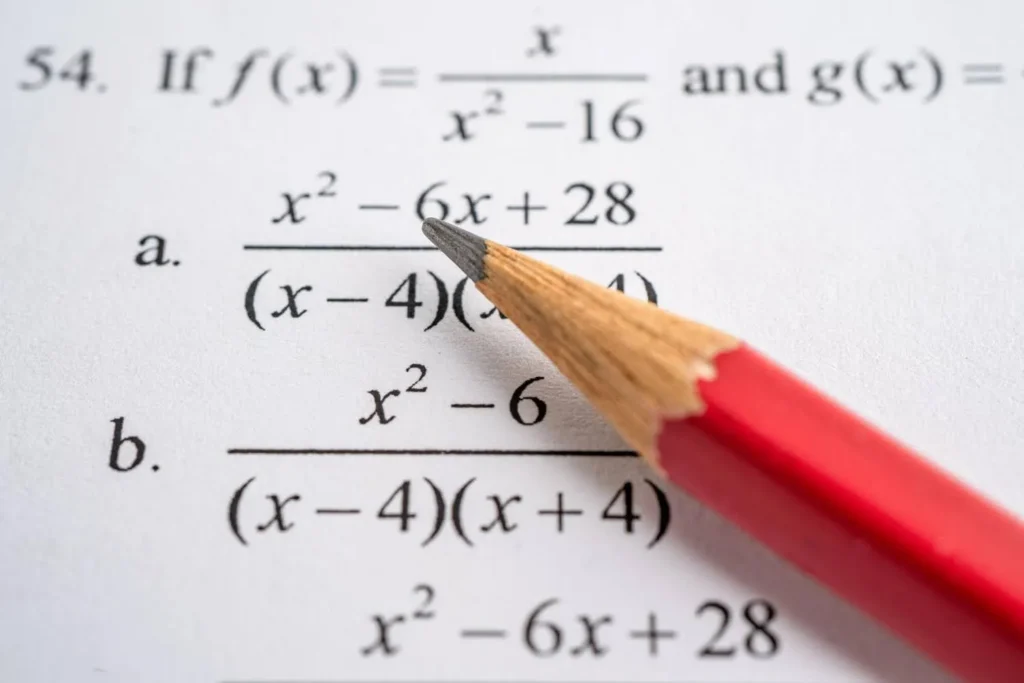
For students tackling algebra or complex heuristics, confusion often arises when variables are ambiguous.
Encourage the habit of writing “Let x be the number of red marbles” or “Let 1 unit be the cost of a pen” at the very start of the solution.
When variables are clearly defined, it prevents the student from getting lost halfway through the equation and forgetting what x actually represents. This is particularly important for Math Olympiad training where problems are multi-layered.
16. The Importance of Sleep Before Exams
Carelessness is often a symptom of a tired brain. If a child is sleep-deprived, their working memory and attention span suffer drastically. No amount of studying the night before can compensate for a lack of focus during the exam.
Ensure your child gets at least 8 to 9 hours of sleep in the week leading up to the exam. A rested brain is sharper, calmer, and far less prone to the erratic lapses in concentration that cause careless errors.
17. Hydration and Stress Management

Finally, physical well-being during the exam affects accuracy. Dehydration can lead to a drop in concentration. Remind your child to take small sips of water if allowed. With a more relaxed mind and body, they can master math problem solving in no time.
Furthermore, anxiety causes rushing. When a student feels “kancheong” (flustered), they write faster and think less. Teach them a simple breathing technique: if they feel panic rising, close their eyes, take a deep breath for 3 seconds, and exhale for 3 seconds. This resets the brain’s focus and allows them to proceed with a steady, careful hand.
Conclusion On How To Reduce Careless Mistakes In Math
Reducing careless mistakes is not about doing more exam papers blindly; it is about changing the habits your child uses to tackle those papers. Carelessness is often just a lack of a systematic checking routine.
By implementing these practical strategies, such as maintaining a mistake log, tracing numbers to avoid transfer errors, and performing sanity checks, you can help your child stop throwing away easy marks. Accuracy is a skill that can be trained, just like multiplication or division. With patience and consistent practice of these habits, your child can reach their full potential.
If you want expert guidance to help your child master these habits and excel in PSLE or Math Olympiad, contact us at Tutify.
Frequently Asked Questions About Careless Math Mistakes
How Can I Stop Making Silly Mistakes In Math?
To stop making silly mistakes, you must identify why they happen. Start by keeping a mistake log to find patterns in your errors. During exams, slow down and vocalise steps in your head, use your finger to trace numbers when copying them, and always re-read the final sentence of the question to ensure you are answering exactly what is asked.
Why Does My Child Make So Many Careless Errors In Math?
Children often make careless errors due to a lack of focus, rushing through the paper, or poor handwriting. It can also be caused by “cognitive overload,” where they are trying to hold too much information in their head (mental math) instead of writing it down. Anxiety and lack of sleep also play significant roles in reducing attention to detail.
What Are The Most Common Careless Mistakes In Primary School Math?
The most common mistakes in Singapore Primary Math include:
- Transfer errors: Copying the wrong number from the question to the working.
- Unit errors: Forgetting to convert kg to g or minutes to hours.
- Calculation errors: Simple addition or subtraction slips.
- Misreading the question: Calculating the “total” when asked for the “remainder.”
Does Checking Work Actually Reduce Math Errors?
Yes, but only if done correctly. Simply staring at the working is rarely effective because the brain ignores errors it has already accepted. Effective checking involves “working backwards,” doing the calculation again on a fresh piece of paper (blank slate method), or using estimation (sanity checks) to see if the answer is logical.
Is It Better To Do Mental Math Or Write It Down?
For exams, it is almost always better to write it down. While mental math is a good skill, it leaves no evidence. Writing down the working offloads data from the brain, reducing the chance of memory lapses. It also allows the student (and the marker) to trace the steps and spot exactly where a calculation went wrong.
How To Improve Focus During Math Exams?
Improving focus starts with good physical preparation, adequate sleep and hydration. During the exam, students can improve focus by using active reading techniques like highlighting keywords. If they feel their mind drifting or panic setting in, taking a brief 10-second break to breathe deeply can reset their attention span.