
Being “good at math” in Singapore is not just about natural talent; it is about mastering the right strategies and building a consistent routine. The Singapore Math curriculum focuses heavily on conceptual understanding through the CPA approach (Concrete-Pictorial-Abstract) and heuristic problem-solving.
With the right foundation, consistent practice, and expert guidance, any student can improve from a borderline pass to an AL1 or distinguish themselves in Math Olympiad. This guide outlines 18 practical ways to help your child excel in primary school mathematics and prepare effectively for the PSLE.
1. Master the Four Operations
The foundation of all primary mathematics lies in the four basic operations: addition, subtraction, multiplication, and division. Many students struggle with complex problem sums in Primary 5 and 6 not because they do not understand the concept, but because their basic calculation skills are shaky.
In the PSLE, Paper 1 does not allow the use of calculators. This section tests speed and accuracy. If a student spends too much time calculating 15×14 manually or makes a careless mistake in simple subtraction, they lose easy marks. To be good at math, your child must practise these operations until they are second nature.
Regular drilling of standard algorithms helps ensure that when they face a difficult 4-mark word problem, their cognitive energy is spent on solving the problem, not on the calculation itself.
2. Memorise Times Tables Up to 12×12
While we often emphasise understanding over rote memorisation, the times tables are an exception. Instant recall of multiplication facts up to 12×12 is non-negotiable for students from Primary 3 onwards.
When a child enters Upper Primary, they will encounter topics like fractions, ratios, and percentages. These topics require frequent simplification and finding common denominators. A student who has to skip-count on their fingers to find that 7×8=56 will be at a significant disadvantage compared to a peer who knows it instantly.
Slow recall slows down the entire paper, leading to time pressure in exams. Make sure your child practises their times tables daily until the answers come automatically.
3. Understand the Concrete-Pictorial-Abstract (CPA) Approach
Singapore Math is famous globally for its CPA approach. To help your child be good at math, it is important to respect this learning progression. Parents often make the mistake of jumping straight to abstract numbers and equations.
Concrete: For younger children (P1-P2), use physical objects like blocks, counters, or even money to demonstrate concepts.
Pictorial: Once they grasp the physical concept, move to drawing pictures or models to represent the problem.
Abstract: Only when the pictorial stage is mastered should you introduce the abstract equations (e.g., 2+3=5).
If your child is stuck on a difficult concept, go back a step. Use drawings or objects to explain it. This builds a deep conceptual understanding that prevents confusion later on.
4. Strengthen Number Bonds and Number Sense
“Number sense” is the ability to understand the relationship between numbers. In the lower primary years, Singapore schools focus heavily on “Number Bonds” (e.g., knowing that 7 is made up of 5 and 2, or 3 and 4).
A child with strong number sense can manipulate numbers easily in their head. They know that to add 9 to 5, they can take 1 from the 5 to make the 9 a 10, leaving 4 behind (10+4=14).
This skill is critical for mental sums and for simplifying algebraic thinking in later years. You can improve number sense by playing math games that require splitting and combining numbers in different ways, rather than just following a set formula.
5. Develop Mental Math Techniques

Paper 1 of the PSLE Math exam is a sprint. To finish it on time with high accuracy, students need sharp mental math skills. Reliance on written working for every single small calculation wastes precious minutes.
Encourage your child to use mental shortcuts. For example, when multiplying by 4, they can double the number and then double it again. When adding a number close to 100 (like 98), add 100 and subtract 2. These small techniques add up. A student who is good at mental math approaches the exam with more confidence and less fatigue, as they are not bogged down by endless vertical workings in the margins.
6. Become Proficient in the Bar Model Method
The Bar Model Method is perhaps the most distinct feature of the Singapore Math curriculum. It is a visual tool that allows students to convert complex word problems into simple diagrams.
There are two main types of models your child must master:
Part-Whole Models: Used to show how a total is divided into parts.
Comparison Models: Used to show the difference between two quantities (e.g., “Ali has 3 times as many stickers as Ben”).
For P5 and P6 students, the model method is the “secret weapon” for solving challenging word problems involving fractions, ratios, and percentages. If your child cannot visualise the problem, they cannot solve it. Practise drawing models for every word problem, even the easy ones, to build the habit.
7. Apply the “Guess and Check” Heuristic Systematically
“Guess and Check” is a valid heuristic taught in schools, but it often frustrates students because they guess randomly. To be good at this method, your child must learn to guess systematically.
Teach them to create a table with columns for the variables and the total. Start with a logical guess (e.g., split the numbers halfway). Check the result. If the total is too high, adjust the numbers in a specific direction. If it is too low, adjust the other way. By following a pattern, the “Guess and Check” method becomes a reliable way to converge on the answer, rather than a game of luck.
8. Master the “Work Backwards” Strategy
This heuristic is essential for questions where the final outcome is given, but the starting number is unknown. For example: “Susan had some money. She spent $5, received $10 from her mother, and then had $20. How much did she have at first?”
To solve this, the student must reverse the operations. If the question says “add,” the student must subtract. If it says “multiply,” the student must divide. Mastering this technique requires practice in identifying the correct sequence of events and carefully reversing them one by one. It is a common method required for flowchart questions and multi-step word problems.
9. Utilise the “Look for a Pattern” Heuristic
Pattern recognition is a key skill tested in both the PSLE and Math Olympiad competitions. Questions may present a sequence of numbers (e.g., 1, 4, 9, 16…) or a growing pattern of shapes and ask for the 100th term.
To be good at these questions, students should not try to list everything out. Instead, they need to find the rule connecting the term number to the value. Is it adding a constant number? Is it a square number? Encouraging your child to look for relationships rather than just counting will help them solve these problems quickly and accurately.
10. Learn the “Assumption” (Supposition) Method
For Upper Primary students, the “Assumption Method” (also known as Supposition) is a faster alternative to Guess and Check for questions involving two variables and a total. A classic example is the “chickens and rabbits” problem where you are given the total number of heads and legs. These are among the most creative methods to solve math problems.
The method involves assuming all animals are chickens (or all are rabbits). Calculate the total legs based on this assumption, find the difference from the actual total, and divide by the difference in legs per animal. This method is purely mathematical and eliminates the trial-and-error aspect. Mastering this advanced heuristic is often the difference between an AL3 and an AL1 student.
11. Practise Consistency Over Intensity
Math is a skill, much like playing the piano or learning a language. You cannot become good at it by cramming. A student who practises for 5 hours only on Sundays will not retain as much as a student who practises for 30 minutes every day.
Consistent daily practice helps build “muscle memory” for standard question types. It keeps the concepts fresh in the mind. Establish a routine where your child does a few math questions every single day. This reduces exam anxiety because math becomes a normal part of their daily life, rather than a massive hurdle to overcome once a week.
12. Create and Maintain a “Mistake Journal”
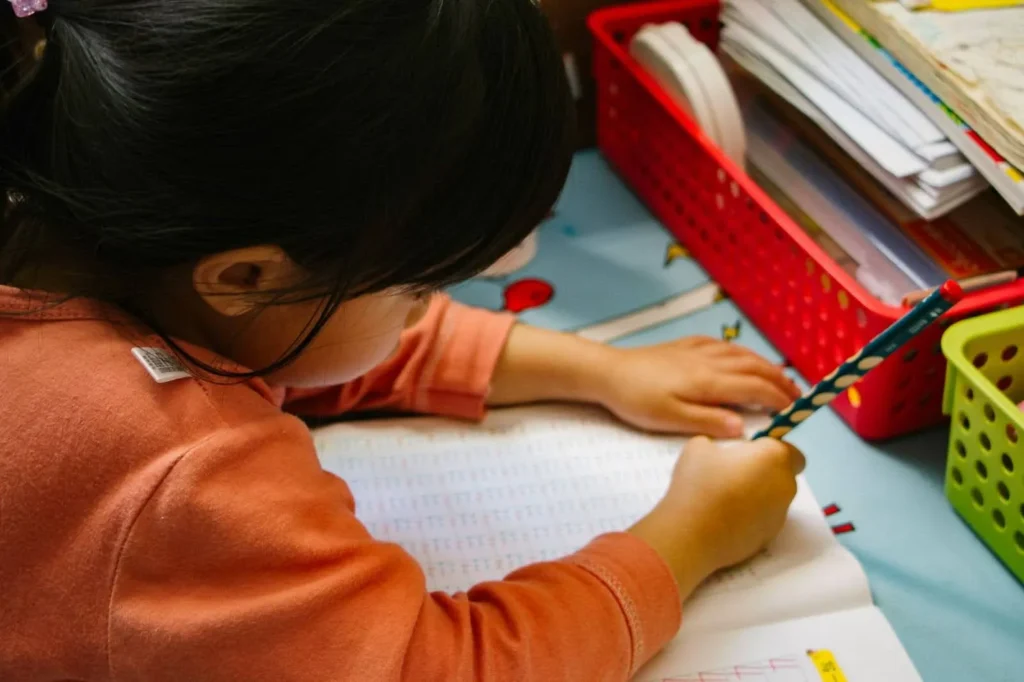
The most effective way to improve math scores is to learn from errors. Many students do a practice paper, look at the score, and then throw it away. This is a wasted opportunity.
Have your child keep a “Mistake Journal.” Whenever they get a question wrong, they should cut it out (or copy it) and paste it into the journal. Next to it, they must write down why they got it wrong (e.g., “calculation error,” “used wrong formula,” “misread the question”). Then, they must redo the question correctly. Before any major exam like CA1, SA2, or PSLE, this journal should be the first thing they review. It highlights their specific weaknesses and prevents them from making the same mistakes twice.
13. Prioritise Quality of Practice Over Quantity
There is a misconception among many Singaporean parents that buying more assessment books leads to better results. This often leads to burnout and “mindless drilling.”
It is better to do 5 challenging questions that require deep thinking than to do 50 easy questions that the child already knows how to solve. If your child is getting 100% on a worksheet, it is too easy. They need to be stretched. Focus on quality questions that test different heuristics and concepts. This ensures that their study time is efficient and that they are actually learning, not just keeping busy.
14. Use the “Teach It Back” Technique
One of the best tests of understanding is the ability to explain a concept to someone else. This is often called the Feynman Technique.
If your child is struggling with a topic, or if you want to verify they truly understand it, ask them to play the role of the teacher. Ask them to explain how they solved a specific problem to you step-by-step. If they stumble or say “I just know,” they likely don’t understand the underlying concept. If they can explain it in simple terms, they have mastered the material. This active recall reinforces their learning significantly.
15. Simulate Exam Conditions at Home
Many students are good at math in a relaxed environment but crumble under the pressure of the exam hall. To bridge this gap, you must simulate exam conditions at home.
When doing practice papers, set a timer. Remove all distractions. Do not allow them to refer to textbooks or ask for help. A good rule of thumb for PSLE Math is 1.5 minutes per mark. This means a 4-mark question should take about 6 minutes. Training with a clock helps students develop a sense of urgency and teaches them when to skip a tough question and move on, ensuring they finish the paper.
16. Master the Art of Checking Answers
“Check your work” is the most common advice given to students, but few know how to do it properly. Simply reading the working again is ineffective because the brain tends to skip over its own mistakes.
Teach your child specific checking techniques.
Reverse Calculation: If they used addition to find the answer, subtract to see if they get back to the starting number.
Estimation: Does the answer make sense? If they calculated the height of a classroom door to be 200 metres, estimation tells them it is wrong immediately.
Substitution: Put the final answer back into the original word problem to see if it fits the scenario.
17. Identify Keywords in Word Problems
Math word problems in Singapore are known for being tricky. However, they almost always contain “keywords” that hint at the correct method to use.
Train your child to highlight these keywords. Terms like “remainder,” “as many as,” “fraction of the total,” or “constant difference” are triggers. For example, if a question involves age, the difference in age between two people always remains constant. Recognising these keywords instantly tells the student which heuristic strategy to apply, saving time and reducing confusion during the exam.
18. Consider Math Olympiad and Professional Tuition
Sometimes, school materials alone are not enough to push a student to the highest bands of achievement. If your child is finding school math too easy, consider Math Olympiad training. It exposes them to non-routine problems that develop lateral thinking and resilience, skills that are incredibly useful for the hardest PSLE questions.
Conversely, if your child is struggling, professional tuition can provide the targeted support they need. A specialised tutor can diagnose exactly where the foundation is weak, be it in fractions or spatial visualisation, and provide customised materials that generic assessment books cannot. This expert guidance can be the catalyst for a significant grade jump.
Conclusion On Getting Better At Math
Becoming good at math in the competitive Singapore context is a journey that involves more than just memorising formulas. It requires a solid grasp of the four operations, a deep understanding of the CPA approach, and the mastery of powerful heuristics like the Bar Model and Assumption Method.
By focusing on consistent, quality practice and learning from mistakes through a journal, students can build the confidence and skills needed to tackle the PSLE with ease. Whether your goal is to help a struggling learner pass or to push a high achiever towards an AL1, these strategies provide a clear roadmap to success.
If you are looking for specialised support to help your child master these strategies and achieve their full potential, contact us at Tutify.
Frequently Asked Questions On How To Be Good At Math
How Can I Improve My Primary Math In Singapore?
To improve primary math, focus on balancing the “drill” of basic operations with the “skill” of problem-solving heuristics. Ensure your child has a strong foundation in multiplication tables and number bonds. Consistent daily practice using the Bar Model Method and carefully analysing mistakes from past year papers are key steps to improvement.
What Are The Different Math Heuristics?
Common Singapore Math heuristics include Model Drawing, Guess and Check, Systematic Listing, Working Backwards, Looking for Patterns, and the Assumption (Supposition) Method. These strategies provide structured ways to approach complex word problems that cannot be solved with simple equations alone.
Is Math Olympiad Useful For PSLE?
Yes, Math Olympiad training is very useful for PSLE. While Olympiad questions are generally harder than standard school questions, the training develops critical thinking, logical reasoning, and problem-solving resilience. These skills make the “differentiation” questions (the hardest ones) in the PSLE Math paper feel much more manageable.
How To Help A Child With Math Anxiety?
To help a child with math anxiety, start by going back to basics using the CPA approach (using physical objects and drawings) to make math less abstract and intimidating. Focus on small wins and celebrate effort rather than just the final grade. Breaking difficult problems into smaller, manageable steps can also build confidence.
What Is The CPA Approach In Singapore Math?
The CPA approach stands for Concrete, Pictorial, Abstract. It is a three-step learning process used in Singapore schools. It builds a tangible understanding of math by starting with physical objects (Concrete), moving to drawings or diagrams (Pictorial), and finally introducing numbers and symbols (Abstract).
How Many Hours Should A Student Practice Math Daily?
For primary students, 30 to 45 minutes of focused, high-quality practice daily is usually sufficient to see steady improvement without causing burnout. It is better to have short, consistent daily sessions than long, infrequent cramming sessions. Consistency helps build long-term memory and retention.